
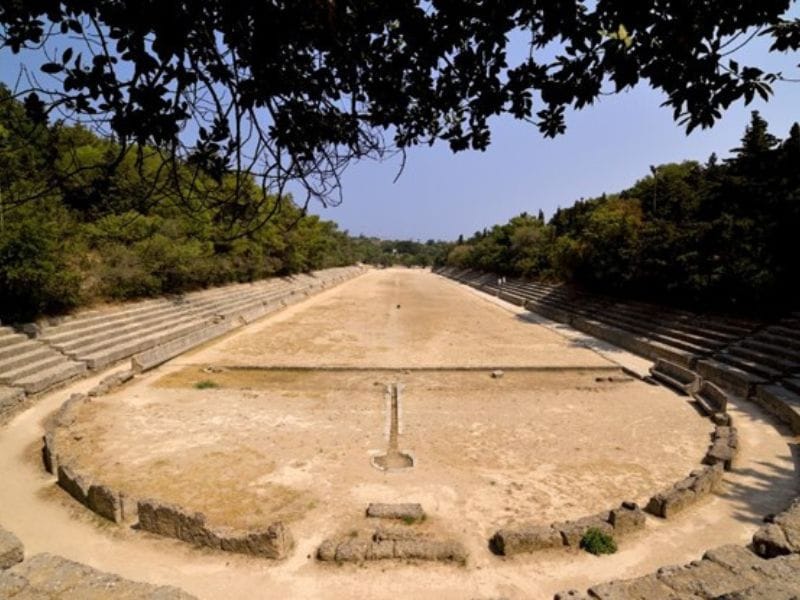
The Stylobate in Acropolis of Rhodes may look like a small piece of stonework today, but it used to be the base of sacred and civic monuments that stood on top of Monte Smith. The stylobate was the top step of a temple’s platform in Greek architecture. It was the surface on which columns stood and façades rose.
It was not just a technical detail; it was the literal and symbolic base of sanctuaries, connecting the earth below with the beauty of the buildings above. The stylobate on the Acropolis of Rhodes showed how precise and stable Rhodian craftsmanship was. It was carefully placed among temples, stoas, and public spaces.
These stones are all that is left, but they remind us of how important foundations were in shaping the physical and spiritual landscape of the ancient city.
The stylobate was more than just a step in classical Greek architecture. It was the top layer of the crepidoma, which was a stepped platform used to build temples and buildings with colonnades. The stylobate gave the columns a flat surface, which made them stable and kept their proportions in harmony.
Its careful design made it possible to make small changes and curves that made it look perfect. The Stylobate in Acropolis of Rhodes did this job with quiet grace. It connected the raw stone of the hill with the elegance of Doric colonnades, ensuring that sacred and civic spaces rested on a secure, measured base.
Without it, the beauty of temples and stoas would have been both unstable and meaningless.

On the Acropolis of Rhodes, stylobates were made of carefully cut blocks of local limestone that were laid out in exact horizontal courses. The surviving fragment on the upper terrace likely belonged to a colonnaded structure — perhaps a stoa framing the sanctuary or a subsidiary temple.
Its size suggests that it was an important building that helped the Acropolis make sense as a group of temples and public spaces. The blocks fit together perfectly without any mortar, which shows how good the Rhodians were at working with stone.
This was architecture that combined strength and beauty, making sure that every part, from the foundations to the columns, worked together to make a beautiful whole. For the Rhodians, the stylobate was both practical engineering and an aesthetic statement.
The Stylobate in Acropolis of Rhodes had a deeper meaning than just being a place to live. Raised above the stereobate, the lower steps of the platform, it elevated sacred buildings from the ground, creating a sense of transition between the human and the divine.
To step onto the stylobate was to enter a different realm — one set apart for worship, ritual, or civic gathering. Its orientation toward the east allowed buildings to catch the morning sun, reinforcing the symbolism of light and renewal. From an engineering perspective, the stylobate levelled the natural slope of Monte Smith, transforming uneven terrain into a stage for temples and stoas. From a symbolic perspective, it gave the structures both literal height and spiritual presence, lifting the eye and the soul upward.

For modern travellers, the Stylobate in Acropolis of Rhodes may appear as an unadorned stretch of stone, yet standing before it offers a tangible connection to ancient craftsmanship. The surviving foundation, with its horizontal courses of limestone, speaks of the meticulous care with which Rhodian builders planned their Acropolis.
Although the columns and superstructure have long disappeared, the stylobate continues to mark the footprint of a building that once framed processional routes and overlooked the city below. Visitors can imagine rows of Doric columns rising from these stones, their rhythm echoing across the terraces, while the platform itself opened eastward to catch the light.
In its simplicity, the stylobate remains eloquent — a foundation that still carries the weight of history.
The Stylobate in Acropolis of Rhodes may be only a fragment, but it embodies the essence of ancient architectural genius. As the foundation upon which sacred and civic monuments rose, it ensured stability, harmony, and symbolic elevation.
Built from finely dressed limestone, aligned with precision, and oriented to embrace the light, it reflects both the practical skills and the spiritual aspirations of the Rhodians. For visitors, it is a reminder that even the humblest remains can reveal the sophistication of a civilization.
The stylobate was not just a platform; it was the bridge between earth and temple, between the human and the divine, anchoring the legacy of Rhodes firmly in stone.
We use cookies to improve your experience on our site. By using our site, you consent to cookies.
Manage your cookie preferences below:
Essential cookies enable basic functions and are necessary for the proper function of the website.
Stripe is a payment processing platform that enables businesses to accept online payments securely and efficiently.
Service URL: stripe.com (opens in a new window)
WooCommerce is a customizable eCommerce platform for building online stores using WordPress.
Statistics cookies collect information anonymously. This information helps us understand how visitors use our website.
Google Analytics is a powerful tool that tracks and analyzes website traffic for informed marketing decisions.
Service URL: policies.google.com (opens in a new window)
SourceBuster is used by WooCommerce for order attribution based on user source.
You can find more information in our Privacy Policy and Privacy Policy.