

The Temple of Apollo in Rhodes, which embodied the principles of peace, justice, and civic pride, served as the Acropolis‘ spiritual and architectural crown. This sanctuary, which rose on Monte Smith’s upper terrace, served as both a house of worship and a representation of the island’s identity.
The temple, which was devoted to Apollo Pythios, the god of light, prophecy, and music, represented Rhodes’s dedication to striking a balance between civic life and divine authority.
The temple directed the attention of sailors, residents, and worshippers alike with its imposing stairway and shining limestone columns, establishing its presence over the city and the sea.
Even though it is now partially destroyed, its legacy lives on, serving as a reminder to tourists of the crucial part it played in forming the political and cultural center of ancient Rhodes.
In Rhodes, Apollo was regarded as Polieus, the defender of civic order and the defender of the moral fabric of the city, in addition to being a goddess of beauty and prophecy. His temple served as the location for oaths, rites, and ceremonies that united the community because his cult associated religion with politics, the law, and public life.
Apollo’s prominence in local identity was further reinforced by the frequent depictions of him alongside the Delphic tripod on Rhodesian coins. The significance of the god as the defender of law and order is also emphasized in the inscriptions.
Apollo was so important to the Rhodians that the largest temple on the Acropolis was dedicated to him, demonstrating his dual role as a symbol of civic harmony and divine brilliance.
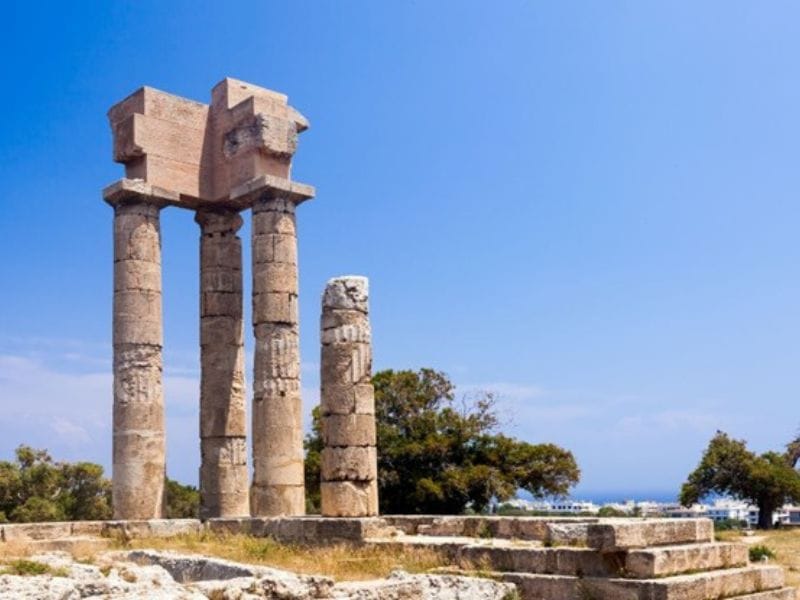
With at least eleven columns along the flanks and probably six across the façade, the Temple of Apollo in Rhodes was a Doric peripteral temple. Constructed from locally quarried limestone, it shone in the Aegean sunlight and was visible from a distance. Its three-step stylobate provided stability and grandeur to its structure.
The temple was purposefully oriented to face east, capturing the morning sun and symbolically connecting the city’s everyday rhythms with the god of light. The structure blended Greek architectural elegance with the imposing presence of a public landmark by combining elegant proportions with monumental scale.
The temple would have had a lively, almost living presence at the center of the Acropolis thanks to its sculptured details, painted accents, and the rhythm of its fluted columns.
The Temple of Apollo in Rhodes approach was among its most remarkable characteristics. The sacred precinct at the top of the Acropolis was connected to the lower terraces by a colossal stairway.
This magnificent climb was profoundly symbolic in addition to being functional. Climbing the steps allowed pilgrims and city dwellers to ascend physically while simultaneously entering a spiritual realm and departing from the city’s public areas in favor of the sanctity of the divine.
During festivals, the stairway led processions, positioning the temple as the ultimate destination. The stairway rising toward the temple from the base of the Acropolis formed a strong visual axis, confirming Apollo’s function as Rhodes’ leader. The design brought architecture and ritual together, elevating both body and spirit.
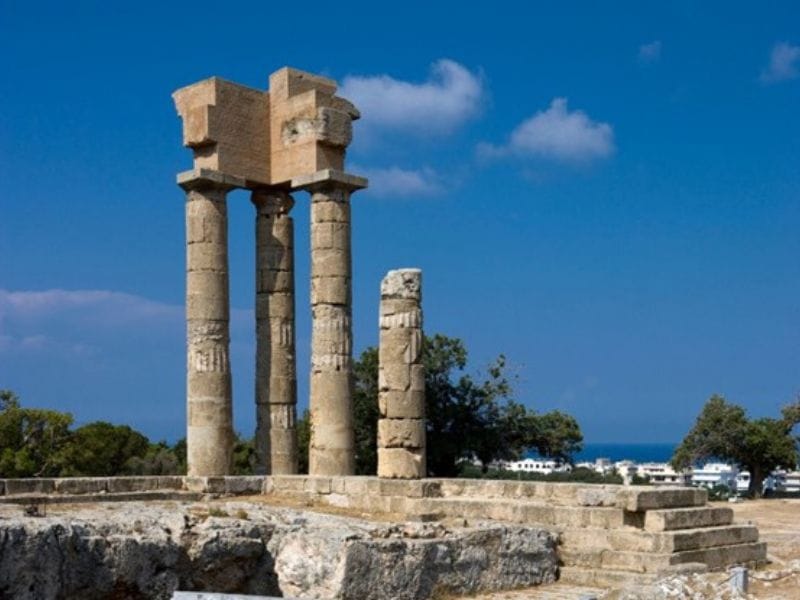
The Temple of Apollo in Rhodes suffered from the effects of time, much like the rest of the Acropolis. Its foundations were rocked by earthquakes, and much of its stone was later removed for use in newer structures through quarrying. Only pieces of the temple’s cella walls, the crepidoma, and column drums are still standing today.
However, the size and grandeur of the original sanctuary are still conveyed by these ruins. Some of the columns have been re-erected as part of modern restoration efforts, giving visitors a glimpse of its grandeur and assisting them in imagining its former glory.
Travelers can feel the resiliency of the legacy and the fragility of the ancient monuments while strolling among the ruins. As a reminder of Rhodes’ enduring cultural identity and devotion to Apollo, the temple never fails to evoke awe.
More than just a place of worship, the Temple of Apollo in Rhodes served as the city’s civic center and the beating heart of the Acropolis. It brought religious devotion and public life together, ensuring that divine authority governed Rhodes’ affairs. It was dedicated to the god who represented light, prophecy, and harmony.
Its Doric design, imposing staircase, and prominent location atop Monte Smith declared the city’s aspirations as well as the might of the gods. Despite being reduced to partial ruins by centuries of decline, its presence is still felt and provides visitors with a direct connection to the political and spiritual underpinnings of ancient Rhodes.
The temple’s legacy lives on, serving as a reminder that, despite its fragments, it still influences the island’s cultural memory.
We use cookies to improve your experience on our site. By using our site, you consent to cookies.
Manage your cookie preferences below:
Essential cookies enable basic functions and are necessary for the proper function of the website.
Stripe is a payment processing platform that enables businesses to accept online payments securely and efficiently.
Service URL: stripe.com (opens in a new window)
WooCommerce is a customizable eCommerce platform for building online stores using WordPress.
Statistics cookies collect information anonymously. This information helps us understand how visitors use our website.
Google Analytics is a powerful tool that tracks and analyzes website traffic for informed marketing decisions.
Service URL: policies.google.com (opens in a new window)
SourceBuster is used by WooCommerce for order attribution based on user source.
You can find more information in our Privacy Policy and Privacy Policy.