

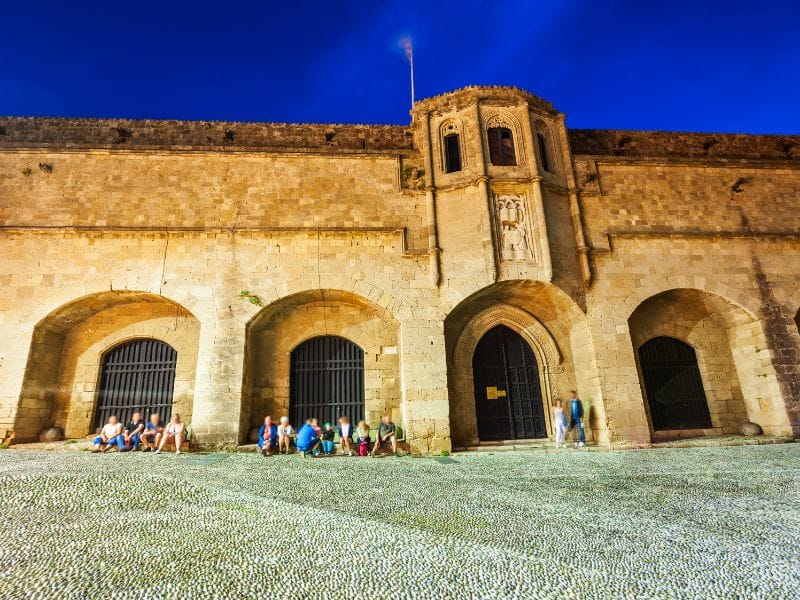
The Courtyard of the Rhodes Museum is more than an open-air entryway—it is the museum’s soul exposed to sunlight and time. Once the operational core of a 15th-century hospital run by the Knights of Saint John, this expansive stone-paved enclosure served both as a place of care and contemplation.
Today, it offers visitors a quiet threshold between the worlds of the living and the long-gone. Cloisters arch in solemn rhythm along its sides, and weathered funerary slabs lean like silent storytellers against their walls.
Marble lions, relics of later centuries, sit with timeless dignity, their gazes fixed in eternal vigil. In this open space, history does not just survive—it resonates.
The light, filtered through medieval arches, lands gently on ancient inscriptions, worn coat-of-arms, and broken altars, echoing the languages and rituals of empires long vanished. The courtyard invites not haste, but pause—a moment to stand still in the breath between centuries.
Constructed in the late 15th century by the Knights of Saint John, the courtyard originally served as the main artery of the hospital complex. Livestock passed through. Supplies were sorted under the arches. Pilgrims and wounded soldiers waited to be seen by the brothers trained in healing. The upper floor above—the Great Ward—once echoed with prayer, pain, and the rustle of monastic care.
Now, the space speaks in quieter tones, but its function as a crossroads remains. It connects the past with the present, not just architecturally but emotionally. This is where the story of the museum begins—not in silence, but in subtle echoes.
At the center of attention stands a crouching marble lion. Though its exact origin is debated, many scholars and curators believe it may have been sculpted during the Venetian period or early in the era of the Knights.
Its presence is symbolic—part guard, part emblem, part enigma. Is it yawning, snarling, or simply posing? That’s part of the magic. The lion has no plaque. No confirmed origin story. Yet it anchors the courtyard with a strange confidence that makes visitors pause.
Beneath the arches lie another kind of relic: stone slabs etched with the coats of arms of fallen knights. These tomb markers, originally placed in churches across the island, were relocated here during the Italian restoration.
Each one is a seal of a life lived in faith and combat. French fleurs-de-lis, Genoese towers, Iberian crosses—they reveal the international nature of the Order of the Knights of Saint John, and the high mortality of their station.
The slabs do not need full names or narratives to move the viewer. Their heraldic symbols speak of identity, rank, and honor. In their quiet dignity, they remind us that this courtyard is also a space of remembrance.
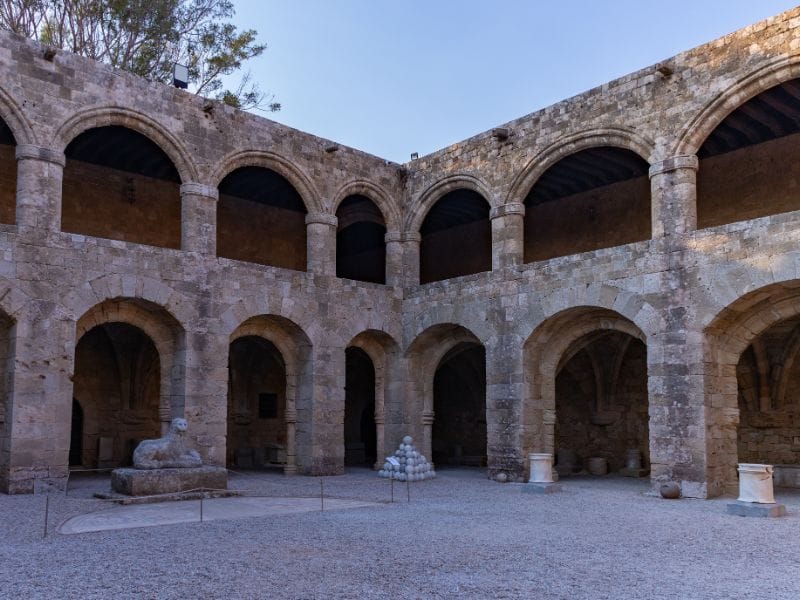
Architecturally, the courtyard reflects a harmonious blend of Gothic order and Crusader functionality. The cloisters offer protection from the sun, and the pointed arches—unchanged since the late medieval period—frame the space with rhythm and strength.
The layout speaks not only of monastic discipline, but of a worldview in which healing, faith, and stone formed an unbroken triad. Through these arches, visitors glimpse both the material remains of Rhodes and its cultural layering: Greek, Roman, Byzantine, medieval, and modern, all embedded in the stone.
In the Courtyard of the Rhodes Museum, history doesn’t wait to be discovered—it greets you at the threshold. Lions, slabs, and arches all play their role in inviting the visitor to slow down and listen. Here, time doesn’t stop—it folds in on itself. And before you move toward the museum’s treasures, the courtyard ensures you’ve already stepped deep into the living memory of Rhodes.
We use cookies to improve your experience on our site. By using our site, you consent to cookies.
Manage your cookie preferences below:
Essential cookies enable basic functions and are necessary for the proper function of the website.
Stripe is a payment processing platform that enables businesses to accept online payments securely and efficiently.
Service URL: stripe.com (opens in a new window)
WooCommerce is a customizable eCommerce platform for building online stores using WordPress.
Statistics cookies collect information anonymously. This information helps us understand how visitors use our website.
Google Analytics is a powerful tool that tracks and analyzes website traffic for informed marketing decisions.
Service URL: policies.google.com (opens in a new window)
SourceBuster is used by WooCommerce for order attribution based on user source.
You can find more information in our Privacy Policy and Privacy Policy.