
Healing in Antiquity: Medical Practices in Rhodes and Lindos
Table of Contents
Sacred Healing and Medical Practices in Rhodes and Lindos
In ancient Greece, medicine was never just about the body—it was about balance, ritual, and belief. The Medical Practices in Rhodes and Lindos reveal a world where healing was woven into the spiritual and civic fabric of daily life.
Diagnosis and treatment were not confined to physicians’ hands alone; they also belonged to priests, pilgrims, and the divine.
Through votive offerings shaped like limbs or internal organs, terracotta figurines left at shrines, and the architectural remains of sanctuaries such as that of Asclepius in Lindos, we see how Rhodians appealed for health both practically and prayerfully.
Illness was understood not merely as a biological disturbance, but as a misalignment between person and cosmos. Sacred spaces offered more than ritual—they offered hope, purification, and a sense of order restored. The legacy of these practices, preserved in the Archaeological Museum of Rhodes, reflects a society where science and faith moved in tandem, each reinforcing the other in the pursuit of healing.
The Cult of Asclepius in Lindos
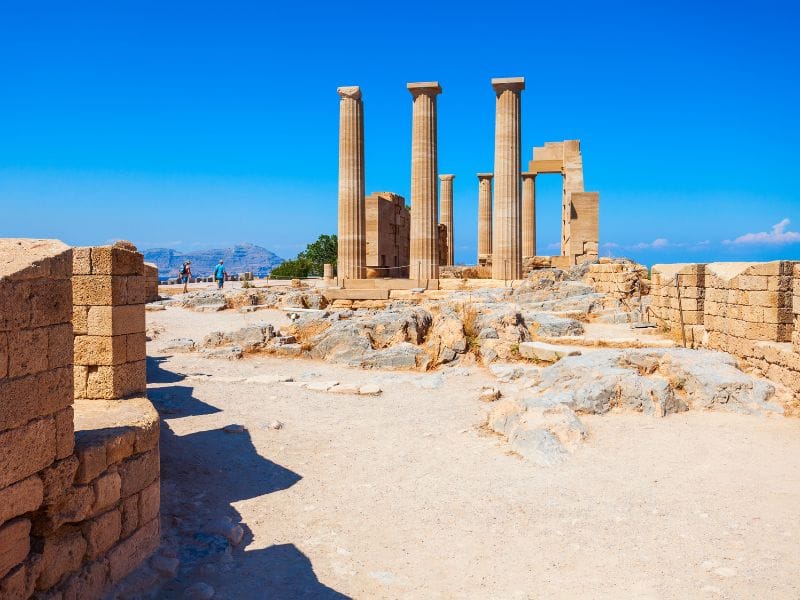
One of the clearest expressions of religious medicine in Rhodes appears in Lindos, where a sanctuary dedicated to Asclepius, the god of healing, welcomed the ill. Pilgrims came to offer prayers and leave votive objects—often terracotta representations of afflicted body parts such as legs, eyes, or wombs.
These objects, simple yet poignant, were both plea and gratitude—an intimate conversation with the divine. The acropolis of Lindos thus functioned not only as a religious site but also as a therapeutic refuge.
Healing and the Kamiros Votives
From Kamiros, a city with deep religious and civic traditions, come votives that may reflect healing rituals: small figurines of women, animals, or isolated anatomical parts. Though their exact use cannot always be confirmed, their form suggests concern with fertility, childbirth, or protection from illness.
Placed in sanctuaries or domestic shrines, these votives point to a world where healing was as much about appeasement and offering as it was about physical intervention.
Medicine Between Magic and Observation
Ancient healing practices in Rhodes moved along a line between empirical care and ritual practice. Priests served as intermediaries, but also as diagnosticians. Medical Practices in Rhodes and Lindos included bathing rituals, dietary prescriptions, and even incubation—sleeping in a sacred space in hopes of a divine dream-diagnosis.
The role of Asclepius was central. In temples, healing combined physical cleansing, spiritual alignment, and visionary experience. There was no sharp line between physician and priest, between body and soul.
Tools, Lamps, and Healing Settings
The museum houses ceramic oil lamps and vessels that hint at the rituals surrounding healing. Light may have been used to guide night rituals or to symbolize divine presence. Other finds suggest ritual ablutions, herbal mixtures, or preparation of sacred salves.
These small, functional items help reconstruct the lived environment of ancient healing—intimate, hopeful, and deeply spiritual.
Cures of Clay and Faith
The Medical Practices in Rhodes and Lindos reflect a world where healing did not divide science from spirit. Through clay figurines, temple rituals, and whispered prayers, ancient Rhodians pursued wellness in all its forms. These practices remind us that health, then as now, was more than survival—it was restoration, relationship, and sacred trust.