
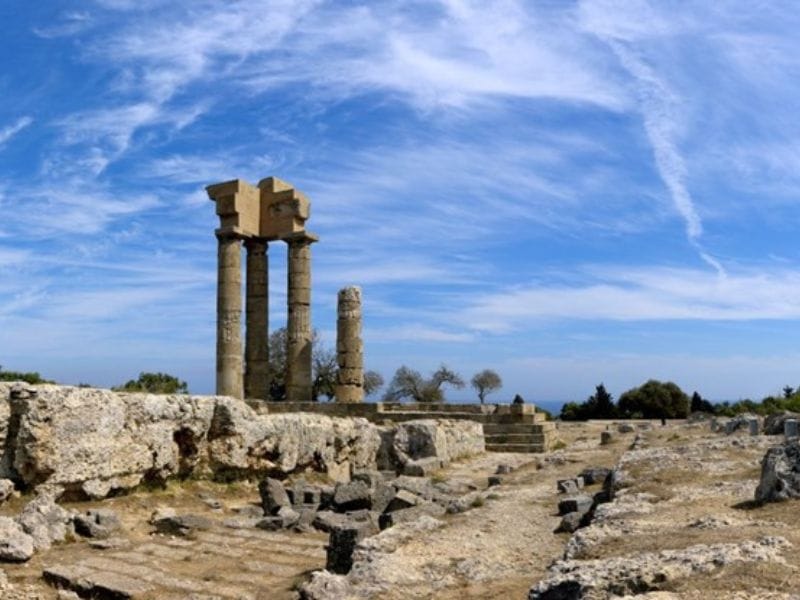
The Library of Acropolis in Rhodes was more than just a place to keep books; it was a place where people could learn, practice rhetoric, and learn about diplomacy. The library was the intellectual heart of Rhodes, surrounded by temples, gyms, and theaters.
This is where students, politicians, and philosophers came together to read and talk about history, philosophy, literature, and law. Along with the gymnasium and the Odeon, it made up a cultural area where people could do physical, artistic, and intellectual activities at the same time.
Even though most of the building is gone, the library is still a symbol of Rhodes’ reputation as one of the best places to learn in the ancient Mediterranean.
Rhodes was famous throughout the Hellenistic world for its rhetoric schools, which drew students from all over the Mediterranean. Future politicians, diplomats, and public speakers went to the island to get better at persuading people and speaking in front of groups. The Library of Acropolis in Rhodes was very important in this intellectual setting.
It had scrolls that kept the knowledge of past generations and gave people the tools they needed to learn, argue, and study. Rhodes was known for its diplomacy and learning not just because of its navy, but also because its people were very articulate.
Many of them learned how to speak well in the cultural spaces of the Acropolis. The library was both a place to store knowledge and a place to learn how to speak, which helped the city have an impact on other countries.
The Library of Acropolis in Rhodes probably looked like a rectangular hall with niches or shelves built into the walls to hold papyrus scrolls. There are only a few traces left. The main room may have had benches and reading tables, and the rooms next to it may have been used as archives or lecture halls.
The building was made of local limestone, and it may have had marble fittings for decorative touches. High-set windows would have let in natural light without letting direct sunlight hit the scrolls, which would have kept the delicate papyri safe.
This design showed how Rhodian architecture was able to find the right balance between being useful and being beautiful. Even though it was small, the library was meant to make people want to read and respect the written word.

The Library of Acropolis in Rhodes wasn’t a quiet place to store things; it was a lively place to learn. Students and scholars would have used the library as both a classroom and a meeting place to read, copy, and talk about texts. This place kept works of philosophy, literature, history, and law safe, which kept Rhodes in touch with the ideas of the larger Greek world.
Teachers might have used the space for lectures, and students might have used it for debates and rhetorical exercises. The library was a living institution that shaped minds and got people ready for the challenges of public life.
The scrolls were more than just parchment; they were a way for Rhodes to show who it was, giving it the intellectual depth that went along with its military and economic strength.
The Library of Acropolis in Rhodes was part of a cultural and intellectual area on the sacred hill. It was close to the gymnasium and the Odeon. Rhodes did not put these spaces for physical training, artistic performance, and intellectual growth next to each other by chance.
The gymnasium worked out the body, the Odeon praised performance, and the library fed the mind. They all showed what the Rhodians thought was the best way to be human: a balance of strength, eloquence, and wisdom. The library on the Acropolis also showed how much the city valued knowledge, which was just as important as worshiping the gods and competing in the stadium.

There isn’t much left of the Library of Acropolis in Rhodes that modern travelers can see. But what makes it important is not the walls that are still standing, but the stories it tells. People who are on the Acropolis terraces can picture rows of shelves full of papyrus scrolls, students reading aloud, and teachers leading discussions about law, philosophy, and poetry.
The library might not be there anymore, but the idea of Rhodes as a city of learning lives on. Today, going to the site means entering a world where learning was sacred, words were as powerful as armies, and seeking knowledge was seen as the key to civic greatness.
The Library of Acropolis in Rhodes was a safe place for the mind, where knowledge was kept, shared, and honored. It was in the middle of a cultural district that brought together sports, art, and intellectual study into a single idea of citizenship.
The library is still a strong symbol of Rhodes’ identity as a place of learning and diplomacy, even though time has taken away a lot of its physical presence. It gives visitors a chance to think about how important knowledge is and how it helped shape one of the most important cities in the ancient world.
We use cookies to improve your experience on our site. By using our site, you consent to cookies.
Manage your cookie preferences below:
Essential cookies enable basic functions and are necessary for the proper function of the website.
Stripe is a payment processing platform that enables businesses to accept online payments securely and efficiently.
Service URL: stripe.com (opens in a new window)
WooCommerce is a customizable eCommerce platform for building online stores using WordPress.
Statistics cookies collect information anonymously. This information helps us understand how visitors use our website.
Google Analytics is a powerful tool that tracks and analyzes website traffic for informed marketing decisions.
Service URL: policies.google.com (opens in a new window)
SourceBuster is used by WooCommerce for order attribution based on user source.
You can find more information in our Privacy Policy and Privacy Policy.