
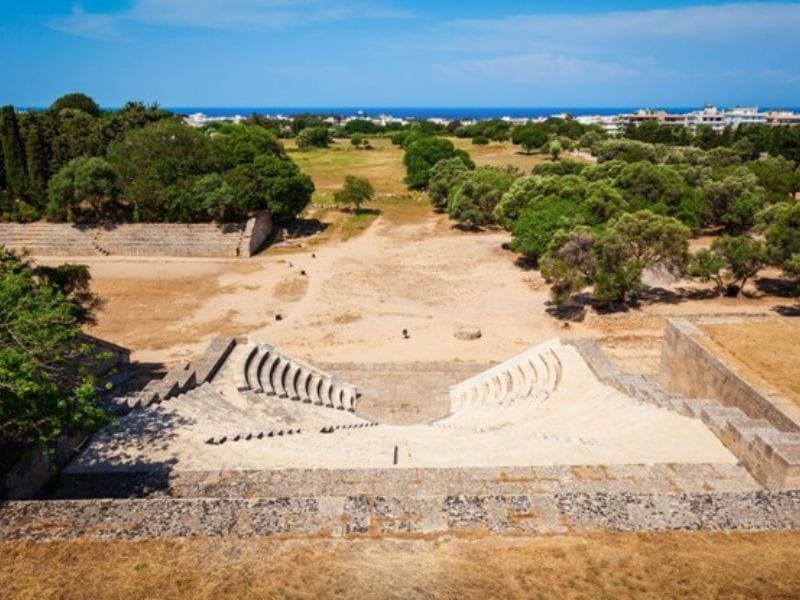
The Gymnasium of Rhodes was not just a space for exercise; it was a cornerstone of civic life, education, and identity in the Hellenistic city. Standing on the terraces of the Acropolis, the gymnasium echoed with the sounds of running feet, wrestling contests, and the voices of philosophers shaping young minds.
Here, people learned how to take care of their bodies and minds at the same time, getting them ready for both military service and public duty. It was more than just a place to train; it was a school of life where strength, discipline, eloquence, and cultural refinement were turned into the ideals of being a Rhodian citizen.
The gymnasium was an important part of civic education in ancient Greece, and Rhodes was no different. The Gymnasium of Rhodes was where young men prepared to become full citizens, receiving both physical and intellectual training.
Wrestling, running, and throwing the discus helped them learn discipline and endurance, while philosophy, music, and rhetoric lessons helped them think more clearly. This combination ensured that the city’s youth were ready not only for military defence but also for leadership in civic affairs.
The gym was also a place where people made friends, shared ideas, and strengthened their values. It reflected the Rhodian belief that a well-rounded citizen must be strong in body, wise in thought, and eloquent in speech.
The Gymnasium of Rhodes was designed as a large rectangular complex surrounded on three sides by colonnaded stoas. These provided shelter from sun and rain, allowing training in every season. The open courtyard at the centre was used for running, wrestling, and other athletic exercises.
Adjacent rooms included apodyteria (changing areas), bathing facilities, and lecture halls where instruction in philosophy and rhetoric took place. Built from local limestone, the architecture blended practicality with elegance. Doric columns framed the exterior, while Ionic details may have adorned the interior, reflecting Rhodian refinement.
The floors were likely packed earth or stone slabs, while terracotta tiles covered the roofs. Together, these features created a space both functional and beautiful, embodying the city’s devotion to balance between strength and culture.

Life in the Gymnasium of Rhodes was filled with energy and variety. At dawn, young men gathered for athletic exercises, sparring with spears, running drills, or practising wrestling techniques. Later in the day, instruction turned to philosophy and rhetoric, where future statesmen learned to reason and persuade.
Music and poetry were also part of the curriculum, reflecting Rhodes’ reputation for excellence in the arts. Festivals brought added vibrancy: the gymnasium hosted competitions, processions, and rehearsals for public events. In this way, it functioned as both a school and a civic centre, preparing youth for every aspect of public life.
It was not a space of isolation but of community, where ideals of strength, eloquence, and cultural pride were nurtured side by side.
The Gymnasium of Rhodes played a central role in the city’s major celebrations, particularly the Halieia, the festival dedicated to Helios, the island’s patron god. From here, processions began toward the stadium, where athletic contests and chariot races honoured the deity.
During these times, the gymnasium became a hub of activity, filled with athletes, musicians, and spectators. It also hosted preliminary competitions, training sessions, and gatherings that united the community in shared devotion.
By linking athletic practice with religious ritual, the gymnasium embodied the deep connection between body, spirit, and the divine. It was not only a training ground but also a stage where the ideals of Rhodes were displayed to citizens and visitors alike.

For today’s traveller, the remains of the Gymnasium of Rhodes may be fragmented, but they still reveal much about its former grandeur. Foundations of colonnades, traces of stoas, and outlines of its rectangular plan provide a clear sense of scale.
Standing within these ruins, visitors can imagine the rhythm of athletic drills, the voices of teachers echoing in lecture halls, and the festive crowds preparing for the Halieia games. The gymnasium’s location, integrated with the Odeon, stadium, and other monuments of the Acropolis, shows how carefully Rhodes planned its civic and cultural spaces.
Though time and earthquakes have taken their toll, the site continues to tell the story of a city where education was complete only when body, mind, and character were shaped together.
The Gymnasium of Rhodes was far more than an athletic facility. It was a civic institution that embodied the city’s values, ensuring that its youth grew strong, wise, and prepared for public life. Through its architecture, daily routines, and role in festivals, it expressed the Rhodian belief in balance between physical excellence and intellectual cultivation.
Today, the ruins of the gymnasium remind us of a society that understood citizenship as a holistic ideal, uniting strength, discipline, eloquence, and cultural pride. The legacy of the gymnasium continues to inspire visitors, offering a window into the world of ancient Rhodes and its vision of human excellence.
We use cookies to improve your experience on our site. By using our site, you consent to cookies.
Manage your cookie preferences below:
Essential cookies enable basic functions and are necessary for the proper function of the website.
Stripe is a payment processing platform that enables businesses to accept online payments securely and efficiently.
Service URL: stripe.com (opens in a new window)
WooCommerce is a customizable eCommerce platform for building online stores using WordPress.
Statistics cookies collect information anonymously. This information helps us understand how visitors use our website.
Google Analytics is a powerful tool that tracks and analyzes website traffic for informed marketing decisions.
Service URL: policies.google.com (opens in a new window)
SourceBuster is used by WooCommerce for order attribution based on user source.
You can find more information in our Privacy Policy and Privacy Policy.